Reach Product Market Fit
in Months, Not Years
Implement the proven "Sean Ellis 40%" framework, the same method 100s of successful Startups used to iterate their way to Product Market Fit
If 40%+ of users say they'd be
"very disappointed" without your product
→ You've hit PMF
What is the Sean Ellis 40% Framework?
The likelihood of achieving PMF jumps when Startups follow structured validation frameworks
The Framework
Created by Sean Ellis, founder of GrowthHackers
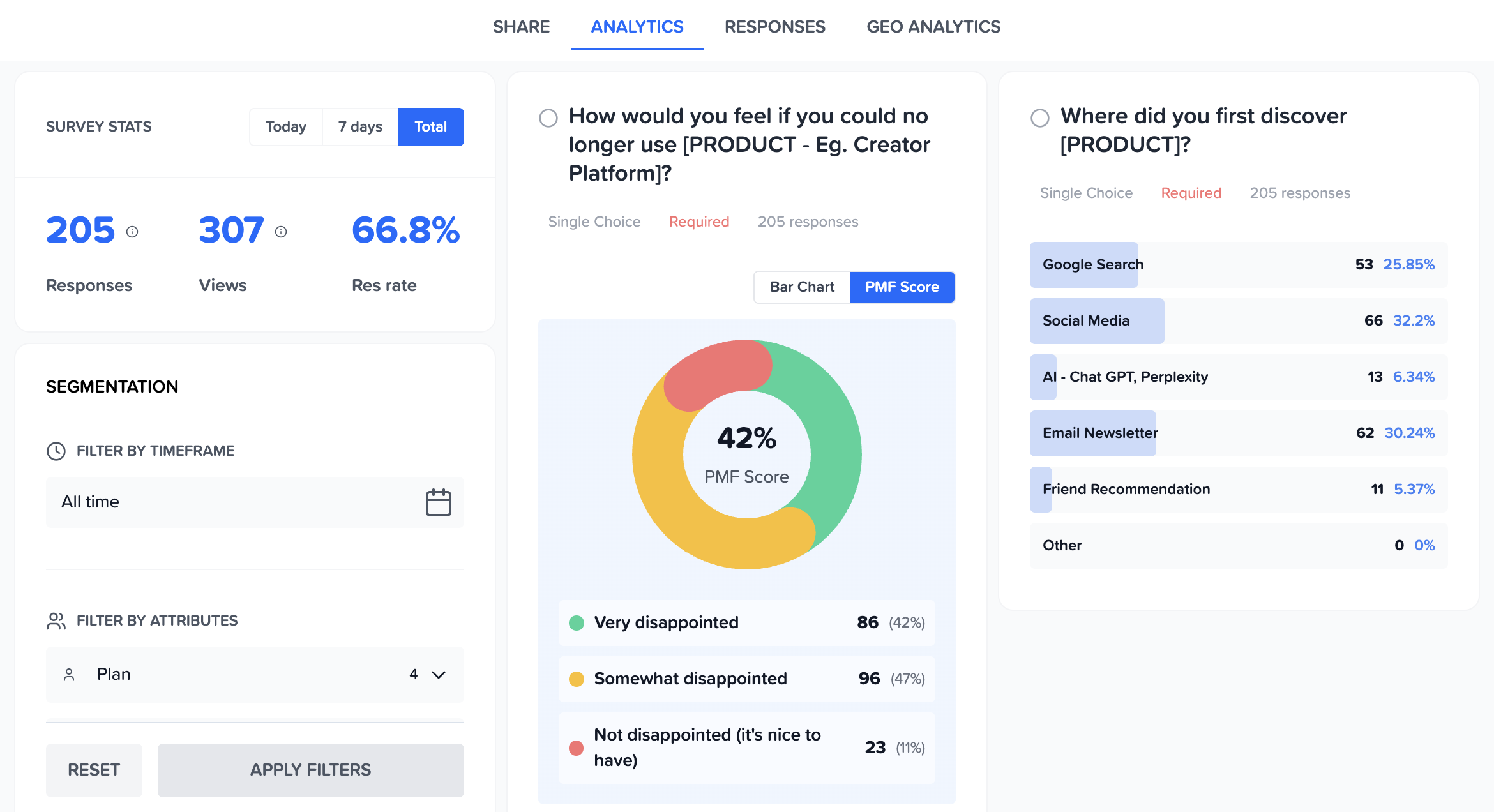
Ask your users one simple question:
"How would you feel if you could no longer use this product?"
Three possible answers:
✓ Very disappointed
✓ Somewhat disappointed
✓ Not disappointed
If 40% or more say
"Very Disappointed"
→ You have Product Market Fit!
Tracks Behavior, Not Just Feedback
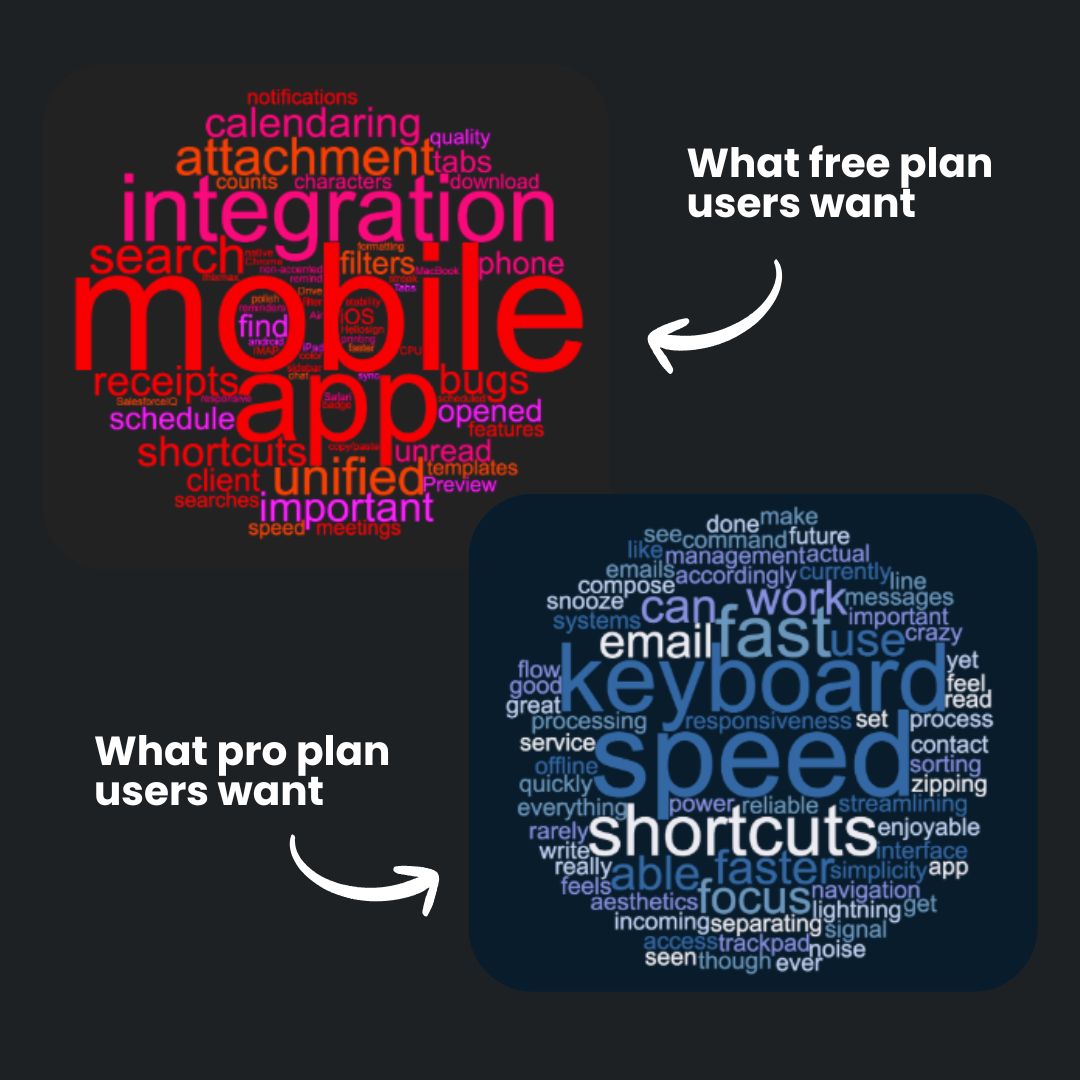
Each response is connected to user behavior data with custom attribute to segment feedback by who your users are and what they do.
Example Attributes:
💡 Result: "Pro users who say 'very disappointed' have 5x higher LTV"
Why It Works
The science behind the metric
📊 Data-Driven
Based on analysis of 100+ startups. Companies above 40% consistently showed strong retention and growth.
🎯 Leading Indicator
Predicts future success better than vanity metrics like signups or page views. It measures genuine need.
🔄 Actionable - Not Just a Score!
Below 40%? The framework doesn't just give you a number. The follow-up questions reveal exactly WHY users aren't hooked and what to fix to reach PMF faster.
Measure the "what" + Understand the "why" = Faster path to PMF
💡 Know what to do next
Not all users are equal. Discover which user segments (by plan, behavior, tenure, or custom attributes) show the strongest PMF signals. Double down on them.
✅ Battle-Tested
Used by Slack, Superhuman, Dropbox, and hundreds of successful startups to validate PMF.
See What Users Do. Hear What They Need. Build What Drives PMF
Identify which Segments helps you achieve PMF fastest and double down on them
Mapster connects user behavior with feedback so you can learn what works in days, not months
Why Generic Feedback Fails
Users Lie
They say "I love this!" then never open your app again. Words mean nothing. Behavior is everything.
You're Treating Feedback from Everyone the Same
Your power users want different features that your tire-kickers. Grouping them all together gives you useless averages.
You Ask at the Wrong Time
Asking everyone on Day 1 gets garbage feedback. Ask after they experience value. Context is everything.
What You Get With Mapster
Connect Behavior with Feedback
See who said "very disappointed" AND how much they actually use your app. Finally, data that matches reality.
Segment by What Matters
Power users vs casual. Creators vs consumers. Paying vs free. Know PMF for each segment, not a useless average.
Ask at the Perfect Moment
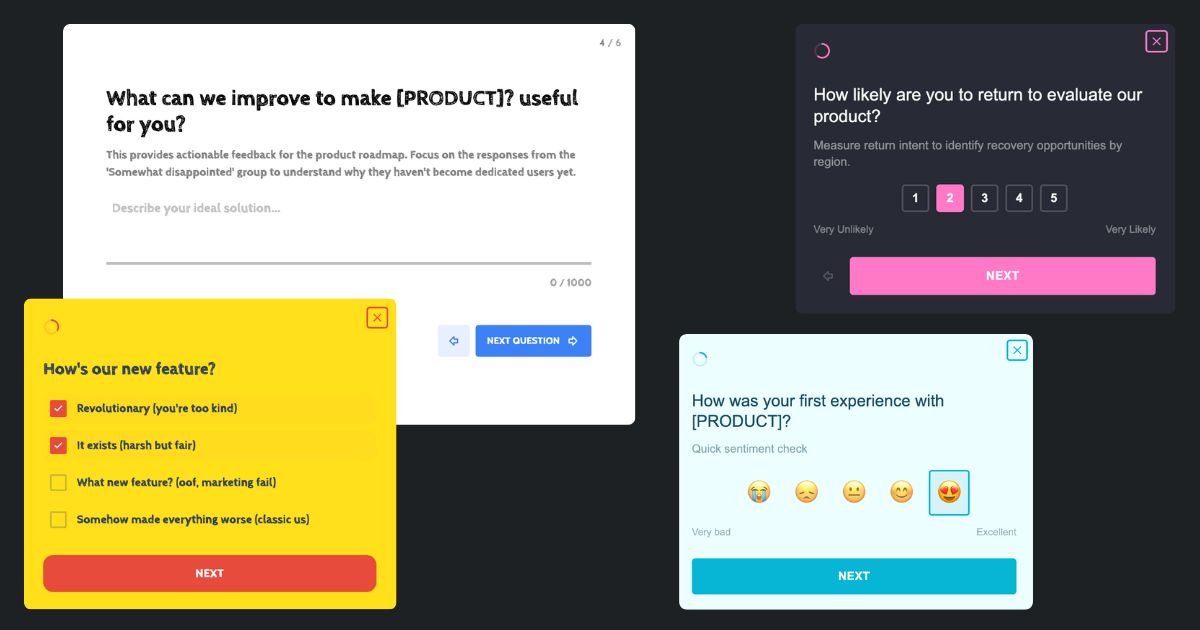
Trigger surveys after milestones: 5th post, 10th connection, first sale. Catch them right when they experience value.
Know What to Build Next
Stop guessing. Your high-PMF users tell you exactly what features matter. Build for them, ignore the rest.
You Don't Find PMF. You Learn It
PMF isn't a moment. It's a continuous optimization loop that runs on three inputs. The faster this loop spins, the faster you learn
Behavioral Data
What users actually do with your product
Logins, features used, connections made, content created. This is truth. Behavior doesn't lie.
Feedback Signals
What they say they want (and why)
Ask power users why they can't live without you. Ask churned users what broke. Context-aware surveys at the perfect moment.
Product Iterations
How quickly you respond and test
Connect behavior + feedback to decide what to ship. Double down on what works. Kill what doesn't. Repeat.
The Outcome:
✓ Users come back because the product keeps improving in the right direction
✓ Revenue grows because you're prioritizing the right needs
✓ Churn drops because the product is learning what matters
It's not magic, just a Structured Validation Framework
Mapster connects all three inputs - behavior tracking, contextual feedback, and actionable insights, so your learning loop runs continuously
Trusted by Hundreds of Successful Startups
Companies that used the Sean Ellis PMF framework to validate and achieve Product Market Fit faster
Collaboration Platform
Used PMF surveys to identify power users and iterate their way to acquisition
Email Client
Built their entire growth strategy around the 40% rule and reached PMF in record time
Cloud Storage
Validated PMF early and scaled to millions of users with this framework
"We've found the PMF survey useful in the early stage to identify the best users to talk to when it's still hard to get significant data."
Watch the Framework Explained
Want us to set up the framework for you for free?
Get in touch and we'll help you get started
"But wait, don't Surveys just..."
Honest answers to common objections about measuring Product Market Fit
Yes, people can be polite or give rushed answers - that's why the PMF survey asks the specific question: "How would you feel if you could no longer use this product?"
This forces users to imagine life without your product, which gets more honest responses than "Do you like our product?"
More importantly, Mapster collects the qualitative "why" alongside the score. You'll see patterns in the feedback: "I'd be very disappointed because [specific reason]" - that's the gold. The score is just a benchmark, the feedback tells you what to do next.
You're right - PMF is messier than a single score. A product can score below 40% just because onboarding sucked, or the target audience wasn't right, not because the core value prop is broken.
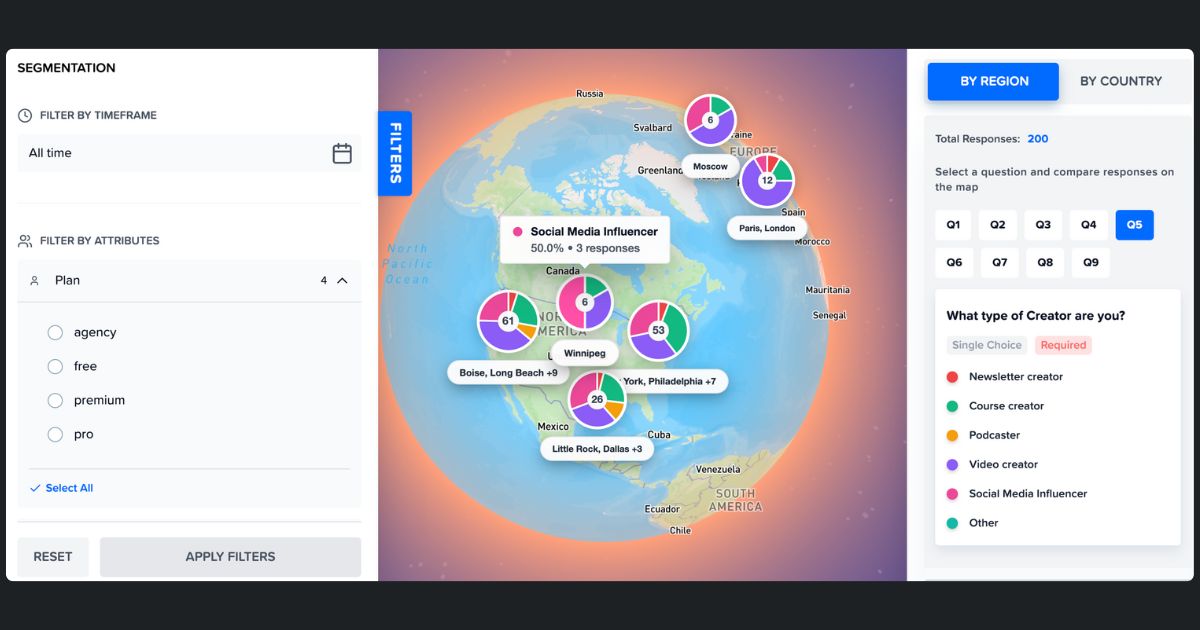
That's why Mapster shows you segmentation by user type, geography, pricing tier, etc. You might discover that enterprise users score 60% PMF while starter plan users score 15% - that tells you exactly where to focus.
The 40% benchmark isn't a "pass/fail" grade - it's a starting point for diagnosis. Think of it like a thermometer: 37°C is normal body temp, but the real insight comes from tracking changes over time and understanding context.
100% agree - organic retention, word-of-mouth, and users pulling you forward are the ultimate PMF signals. But here's the problem: those signals show up after you've already spent months building the wrong thing.
Surveys give you early warning signals before you waste time scaling. If you survey your first 10-15 active users and only 1 says "very disappointed," you know something's off before you spend $10k on ads.
The biggest tell for PMF is when users start complaining loudly when you change something or when a feature breaks - Mapster helps you identify those power users early so you can focus on replicating them, not guessing.
No - this is the biggest mistake founders make. They wait until they've spent months on paid ads or SEO, get hundreds of users, then realize they've been attracting the wrong audience the whole time.
Run your first PMF survey with your first 10-15 active users (people who've actually used the product, not just signed up). This early signal tells you if you're on the right track or need to pivot before scaling.
If you wait until you have 1,000 users to measure PMF, you've already made decisions based on vanity metrics (signups, page views) instead of the signal that actually matters: do people love this enough to be very disappointed without it?
This happens when founders find PMF with a tiny niche but can't replicate it at scale. Classic example: you get 50% PMF score from 20 early adopters who are your friends in the same industry, but it doesn't work for strangers.
The real insight isn't just hitting 40% - it's understanding which segment of users would be very disappointed and whether that segment is large enough to build a business around.
Mapster's segmentation shows you: "Solo freelancers: 15% PMF. Small agencies (3-10 people): 65% PMF." Now you know your ICP (Ideal Customer Profile) and can focus all your marketing/product efforts there instead of trying to be everything to everyone.
Retention and revenue are lagging indicators - they tell you what happened, not why. You can have good retention because of sunk cost ("I already paid for annual plan") or switching costs ("migrating data is too painful"), not because users love your product.
The PMF survey + qualitative feedback gives you the "why" behind the metrics. Example:
- High retention + Low PMF score = Users are stuck, not happy (churn risk when competitor shows up)
- Low retention + High PMF score = Great product, bad onboarding or pricing
- High retention + High PMF score = You're on the right track, double down
Surveys don't replace retention metrics - they give you context to understand what your retention numbers actually mean.
For early-stage (pre-100 users): Survey every active user once, after they've used the product enough to form an opinion (usually after 3-7 days of activity, not 3-7 days since signup).
For growth-stage (100+ users): Survey new cohorts monthly or quarterly. Mapster's widget triggers based on usage patterns, not time-based spam. A user who's logged in 10 times is more likely to give thoughtful feedback than someone who signed up yesterday.
The key is one quick question ("How would you feel if you could no longer use this?") + optional follow-up ("What's the primary benefit you get?"). Takes 30 seconds. Users who love your product want to tell you why - you're giving them a voice, not annoying them.
Don't panic and pivot immediately. First, look at the segmentation and qualitative feedback:
- If one segment scores 50%+ but others score 10%: Focus on the winning segment, ignore the rest
- If everyone scores low but feedback is "I'd use this if [specific feature]": Build that feature, re-survey
- If feedback is vague ("it's fine, I guess"): You might be solving a problem people don't actually have - consider pivot
Example: You score 25% overall, but when you filter for "users who logged in 5+ times in first week," that segment scores 55%. This tells you the product works, but your onboarding or targeting is off - not a pivot situation.
Use Mapster's segmentation to find your hidden winning segment before you throw everything away and start over.
Yes! PMF isn't binary—it's continuous. Reaching 40% in one segment doesn't mean the journey is over. Here's why ongoing measurement matters:
- Geographic expansion: Your product might have 60% PMF in California but 18% in Texas. You need data to know which markets to target next and how to adjust positioning for each region.
- New product lines: Adding a new feature or product? You're essentially hunting for PMF again with a new value proposition. Validate it before full build.
- Market evolution: Your competitors evolve, customer needs change, new alternatives emerge. PMF today ≠ PMF in 6 months. Continuous measurement keeps you ahead of erosion.
- Adjacent segments: You might have strong PMF with small agencies (3-10 employees) but weak PMF with enterprises. Expansion requires knowing which segments show early PMF signals.
Real-world example: Slack achieved initial PMF with tech startups, then had to re-measure and adjust positioning for enterprise, healthcare, education—each market required different features, messaging, and integrations. They didn't "set and forget" PMF; they continuously measured it across expansion.
Use Mapster to track PMF across geographies, segments, and product lines as you scale. This prevents you from expanding into markets where you don't have fit while doubling down on segments where you do.
This is Survivorship Bias in action. You see the Ubers, Facebooks, and Airbnbs—the loud success stories—and think they broke all the rules. But for every billion-dollar company that "didn't measure," there are thousands that burned through millions and failed silently because they couldn't answer: "Why are our users leaving?"
Failure is invisible and un-newsworthy. Following the path of a perceived "survivor" is a statistically dangerous bet. The purpose of measuring PMF is to take the guesswork out and give yourself the highest probability of success, not to try and be a lucky anomaly.
The Truth: They DID measure PMF, just not with a survey form. Successful startups obsessed over a single behavioral metric as their measurement tool:
They might not have had a "PMF Scorecard" in a spreadsheet, but they had an abnormal, unusually high metric that screamed: "This is working!" That metric was their measurement. Startups don't need to measure PMF just to say they did—they need to measure it to know when to pivot and when to scale. It's the difference between gambling and investing.